
Barista Skills and the Evolution of Coffee Craft
488 views
A great espresso can be ruined in less than ten seconds.
Not because the beans were poor. Not because the espresso machine cost too little. More often, it's a tiny mistake—a grinder drifting out of calibration after a humid morning, milk stretched a few degrees too hot, or a rushed tamp that looked fine but wasn't. Anyone who's worked behind a busy café bar has seen it happen. Customers rarely know why one latte tastes incredible while the next feels flat. Baristas do.
Coffee has changed dramatically over the past two decades. The job has shifted from simply operating a machine to managing variables that resemble a small science experiment repeated hundreds of times each day. Yet despite all the technology, the best cafés still rely on skilled hands, careful observation, and experience earned through repetition.
Coffee craft isn't just brewing anymore
Years ago, many cafés depended on pre-ground coffee and fixed recipes. That approach still exists in some places, especially in high-volume chains, but specialty coffee has raised expectations.
Today's barista often manages:
Espresso extraction
Grinder calibration
Water quality
Milk chemistry
Workflow efficiency
Customer education
Equipment maintenance
Those responsibilities overlap constantly.
A rainy afternoon can increase humidity enough to slow coffee flow through the portafilter. The same espresso recipe that produced a balanced 36-gram yield in 28 seconds at opening time may suddenly run in 34 seconds after lunch. Experienced baristas notice immediately. Beginners usually blame the machine.
The grinder matters more than people expect
Many first-time café owners spend most of their budget on an espresso machine.
That's backwards.
A premium grinder often influences cup quality more than upgrading from one commercial espresso machine to another within the same performance class.
Modern cafés commonly rely on grinders such as the Mahlkönig EK43, Mahlkönig E65S GbW (Grind-by-Weight), Victoria Arduino Mythos MY75, or Mazzer Robur. These machines minimize particle inconsistency while allowing extremely fine adjustments measured in microns.
Even then, calibration never truly ends.
A busy café may adjust grind size several times during a shift because variables change continuously:
Variable | Effect on Extraction |
|---|---|
Humidity | Slows or speeds coffee flow |
Bean age | Fresh coffee often extracts differently than coffee rested for two weeks |
Roast level | Darker roasts usually require different grind settings |
Ambient temperature | Influences bean density and machine stability |
That's why skilled baristas pull test shots before opening.
Sometimes after lunch too.
Espresso is controlled chemistry
Coffee brewing isn't guesswork.
The Specialty Coffee Association (SCA) generally recommends brewing parameters that aim for balanced extraction, though cafés intentionally adjust recipes depending on origin, roast profile, and beverage style.
A typical espresso recipe might look like this:
Parameter | Common Range |
|---|---|
Dose | 18–20 grams |
Beverage Yield | 36–42 grams |
Brew Time | 25–32 seconds |
Brew Temperature | 90–96°C |
Pressure | Approximately 9 bars |
Those numbers aren't rules carved into stone.
I've watched experienced baristas intentionally pull a naturally processed Ethiopian coffee slightly faster because extending extraction introduced excessive bitterness. The recipe changed because the coffee demanded it.
That's craft.
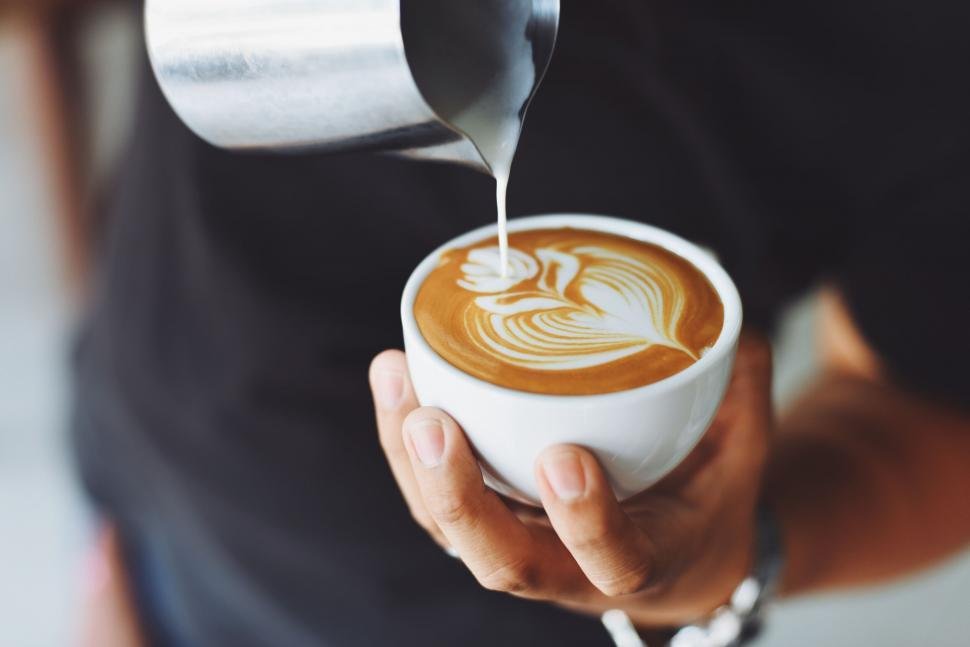
Milk steaming looks simple. It isn't.
Customers usually notice latte art first.
The milk matters far more.
Proper steaming transforms milk into microfoam—a silky texture made from tiny, uniform bubbles instead of large frothy foam.
Most cafés aim to finish milk around 55–65°C (131–149°F). Temperatures much above 70°C (158°F) begin degrading sweetness while creating the cooked flavor many people associate with poorly prepared cappuccinos.
Alternative milks complicate things.
Oat milk often stretches differently than dairy because manufacturers formulate "Barista Edition" products with added stabilizers and vegetable oils specifically to improve steaming performance. Almond milk separates more easily. Soy behaves differently depending on protein formulation.
Learning those differences takes practice.
No manual replaces repetition.
Water quietly controls everything
Coffee is almost entirely water.
Yet it's the variable many beginners ignore.
The SCA recommends brewing water with balanced mineral content because distilled water extracts poorly while excessively hard water dulls flavor and accelerates scale buildup inside expensive equipment.
Commercial cafés frequently install multi-stage filtration systems from companies like BWT, Everpure, or Pentair.
Ignoring filtration creates two expensive problems:
Inconsistent coffee flavor.
Boiler scale that reduces heating efficiency and eventually requires costly servicing.
Replacing a commercial heat exchanger costs far more than replacing water filters.
Technology has changed the modern coffee bar
Espresso machines have become remarkably sophisticated.
Many specialty cafés now use machines with saturated brew groups, PID temperature control, programmable pressure profiling, and digital shot timers.
Examples include:
La Marzocco Linea PB
La Marzocco KB90
Victoria Arduino Eagle One
Slayer Steam LPX
Synesso MVP Hydra
Pressure profiling deserves attention.
Rather than maintaining a constant 9-bar extraction, machines can gradually increase or reduce pressure during brewing. Certain lightly roasted coffees benefit from these profiles because they extract sweetness more evenly while limiting harsh bitterness.
Some cafés pair these machines with Bluetooth-enabled scales from Acaia, which record extraction weights with sub-gram precision and integrate with café workflow software.
Fancy?
Sure.
Necessary?
Not always.
A skilled barista using a well-maintained traditional machine frequently outperforms an inexperienced operator behind equipment costing three times as much.
Workflow wins during the morning rush
The busiest cafés aren't necessarily the fastest.
They're organized.
A smooth coffee bar follows a rhythm:
Grind while the previous shot extracts.
Steam milk during extraction.
Clean the steam wand immediately.
Purge the group head before the next shot.
Reset the station continuously.
One missed cleaning cycle creates problems surprisingly quickly.
Milk residue hardens inside steam wands. Coffee oils accumulate in group heads. Grinder chutes retain stale grounds. Customers rarely notice the source of declining quality until every drink starts tasting slightly off.
Daily cleaning isn't glamorous.
It pays the bills.
Soft skills separate memorable baristas from machine operators
Coffee quality attracts customers.
People bring them back.
A regular customer may order the same flat white every weekday at exactly 8:15 a.m. Remembering their name often matters as much as remembering their preferred roast.
Communication also reduces mistakes.
Experienced baristas confirm unusual modifications instead of assuming:
"Half-strength?"
"Extra hot?"
"Oat milk?"
Those few seconds prevent wasted drinks during busy service.
Training manuals often focus heavily on technical skills while underestimating hospitality. That's a mistake many cafés eventually correct.
Learning never really stops
Coffee keeps evolving.
Processing methods alone have expanded dramatically.
Traditional washed and natural coffees now share shelves with anaerobic fermentation, carbonic maceration, thermal shock processing, and yeast-inoculated fermentations. These techniques produce striking flavor profiles, but they also require different brewing approaches because extraction behaves differently across processing styles.
Competitions push innovation even further.
The World Barista Championship continues influencing café standards worldwide by encouraging precision, sensory evaluation, sustainability, and brewing experimentation. Many techniques that once appeared only on competition stages eventually found their way into neighborhood coffee shops.
Curiosity remains one of the most valuable barista skills.
Training pathways that actually help
Formal certification isn't mandatory, yet structured education shortens the learning curve considerably.
Some respected training options include:
Program | Focus |
|---|---|
Specialty Coffee Association (SCA) Coffee Skills Program | Brewing, barista skills, roasting, sensory, green coffee |
Coffee Quality Institute (CQI) | Coffee quality evaluation and Q Grader certification |
Manufacturer training | Machine operation and preventive maintenance |
In-house café mentoring | Workflow, customer service, consistency |
Many employers still value demonstrated consistency over certificates alone.
Someone who produces identical espresso every morning for six months often proves more valuable than someone holding several certifications but lacking real café experience.
Sustainability is becoming part of the craft
Coffee shops increasingly measure success beyond taste.
Many now reduce single-use waste by encouraging reusable cups, composting coffee grounds, sourcing certified coffees, and improving energy efficiency through newer espresso machines with insulated boilers and programmable standby modes.
Customers ask questions that rarely came up ten years ago.
Where was this coffee grown?
Was the producer paid fairly?
Can this cup be recycled?
Baristas increasingly become educators as much as beverage makers.
That role will likely continue expanding.
FAQs
How long does it take to become a skilled barista?
Most beginners become comfortable with basic espresso preparation after several weeks of regular practice. Developing consistent dialing-in skills, milk texturing, workflow, and customer service typically takes several months, while mastery often comes through years of daily experience.
Is expensive equipment necessary for great coffee?
No. Reliable grinders, fresh beans, quality water, and proper technique usually have a greater impact than owning the most expensive espresso machine available.
Why do cafés adjust grinders throughout the day?
Environmental conditions such as humidity, temperature, bean age, and coffee usage affect extraction speed. Small grind adjustments maintain consistent shot times and flavor.
What is the hardest barista skill to master?
Consistency. Pulling one excellent espresso is relatively easy. Producing hundreds of nearly identical drinks during a busy shift while maintaining speed and hospitality is significantly more challenging.
Are latte art skills essential?
They help, but they're secondary. Proper espresso extraction, balanced milk texture, cleanliness, and customer service should come first. Attractive latte art can't fix poorly prepared coffee.
Looking ahead
Coffee will keep changing as processing techniques, brewing technology, and sustainability practices evolve. The fundamentals, though, remain remarkably steady: fresh coffee, careful observation, disciplined technique, and genuine hospitality. If you're building barista skills, spend less time chasing shortcuts and more time tasting, adjusting, and learning from every cup you make. That's still the fastest path to better coffee.
barista skills
coffee craft
coffee culture
espresso techniques
latte art
specialty coffee
coffee brewing
modern barista
coffee evolution
artisan coffee
Found this helpful? Share it!