
I Replaced My Cheap Grinder with a Premium Burr Grinder: Was It Worth It?
197 views
For years, I convinced myself that coffee beans were the problem.
I'd buy a fresh bag from a respected local roaster, open it with high expectations, brew a cup... and wonder why it tasted flat, bitter, or strangely sour. Sometimes the same bag produced an amazing cup one morning and a disappointing one the next. It made no sense.
The culprit wasn't the beans.
It was my grinder.
A $25 blade grinder had quietly sabotaged every brew. Replacing it with a premium burr grinder completely changed how I looked at home coffee. Not overnight, and not without a few surprises, but enough that I now consider the grinder more important than the coffee maker itself.
Here's what actually happened after making the switch—and whether spending several hundred dollars was worth it.
My old grinder wasn't really grinding
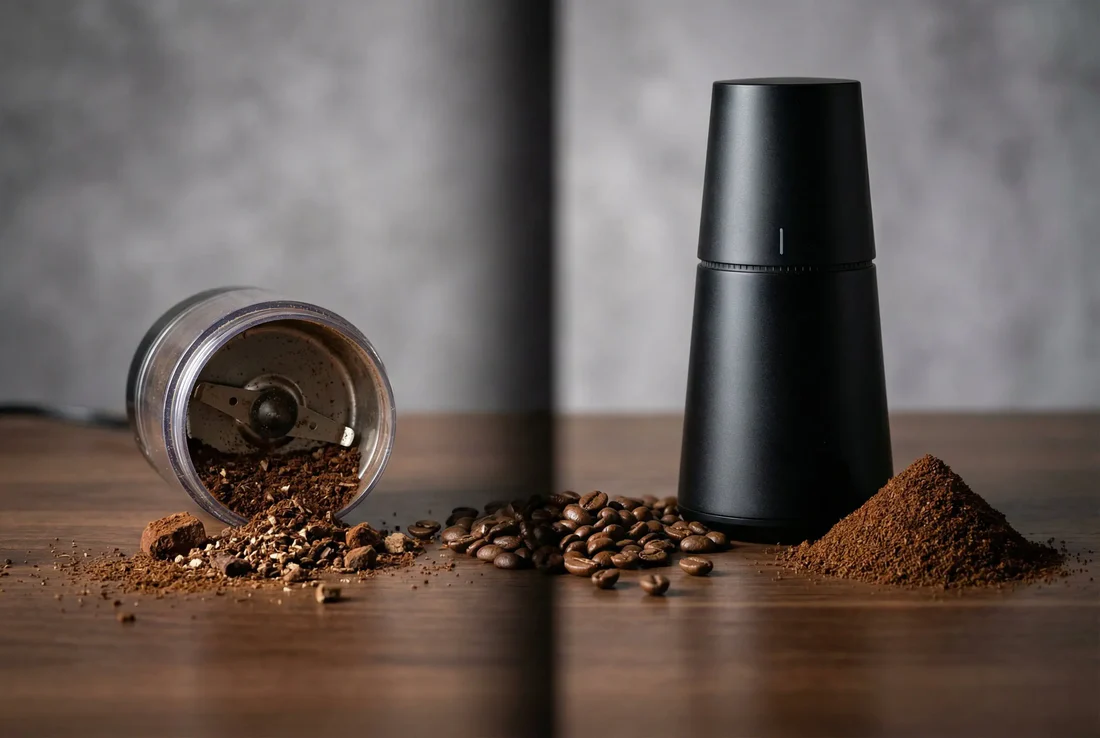
A blade grinder works more like a miniature blender than a precision grinder.
Instead of crushing beans into evenly sized particles, it chops them randomly. After a typical 20-second grind, I noticed something odd when I spread the grounds onto white paper.
There was everything.
Dust-like powder. Medium pieces. Chunks almost the size of cracked pepper.
That inconsistency matters because extraction depends on surface area.
Tiny particles—often called fines—extract extremely quickly, contributing bitterness. Large chunks extract slowly and leave behind sour, underdeveloped flavors. The result is a cup trying to be bitter and sour at the same time.
No brewing recipe can fully fix that.
Coffee researchers and manufacturers have consistently emphasized grind uniformity as one of the biggest factors affecting extraction quality, alongside brew ratio, water temperature, and contact time.
The upgrade
After weeks of reading reviews and watching tear-down videos, I narrowed my choices to several respected grinders:
Grinder | Approximate Price (USD) | Burr Type |
|---|---|---|
Baratza Encore ESP | $199 | 40 mm conical burr |
Fellow Opus | $195 | 40 mm conical burr |
Eureka Mignon Specialita | $450–700 | 55 mm flat burr |
DF64 Gen 2 | $399–499 | 64 mm flat burr |
Niche Zero | Around $650 | 63 mm conical burr |
I eventually chose a premium flat burr model because I wanted better espresso consistency while still brewing pour-over.
The first surprise?
It wasn't quieter.
Premium grinders often use stronger motors—typically between 250W and 350W—and solid metal housings. They're smoother, yes, but not necessarily silent.
First morning impressions
I expected dramatic flavor improvements immediately.
Reality was messier.
The grinder needed calibration.
My espresso shot ran in barely 12 seconds because I had set the grind far too coarse. The next attempt nearly stalled the espresso machine.
Trial and error.
After several adjustments, things settled down.
Then I noticed something I'd never experienced before.
The coffee tasted... clearer.
Individual tasting notes finally appeared instead of blending into one generic "coffee flavor." Chocolate stayed chocolate. Citrus stayed citrus. Floral aromas didn't disappear after the first sip.
Nothing magical happened.
The grinder simply stopped getting in the way.
Burr grinders aren't all the same
People often compare blade versus burr grinders, but there's another layer.
Conical burrs and flat burrs behave differently.
Conical burrs
Most entry-level premium grinders use hardened steel conical burrs between 38 mm and 63 mm.
Advantages include:
Lower retention in many designs
Easier dialing for multiple brewing methods
Generally quieter operation
Lower purchase price
Many home users happily keep grinders like the Baratza Encore ESP or Niche Zero for years.
Flat burrs
Flat burr grinders usually employ burr sets ranging from 54 mm to 98 mm.
Larger burrs can:
Produce tighter particle distributions
Improve clarity
Increase grinding speed
Generate more uniform espresso extractions
That doesn't automatically mean better coffee.
Some people actually prefer the fuller body often associated with conical burrs.
Taste remains personal.
Something nobody mentioned: workflow matters
Grinding coffee isn't just about particle size.
It's about the entire routine.
My cheap grinder required shaking, tapping, stopping, restarting, and guessing.
The premium grinder was almost boring.
Weigh beans.
Grind.
Brew.
Done.
Many newer grinders also support single-dose workflows, meaning you weigh exactly the beans needed for each brew rather than filling a large hopper.
Models like the DF64 Gen 2 include features such as:
Plasma anti-static systems to reduce flying grounds
Bellows for lower retention
Stepless grind adjustment
Easily removable burr carriers for cleaning
Those details sound minor.
After making coffee every morning for months, they aren't.
The hidden cost nobody talks about
Buying the grinder wasn't the end.
Not even close.
I ended up purchasing:
Item | Typical Cost |
|---|---|
Precision coffee scale | $25–80 |
Bean storage canisters | $20–60 |
Burr cleaning tablets | $10–20 |
Grinder brush | $8–15 |
Premium grinders also require maintenance.
Manufacturers commonly recommend cleaning burrs every few months, depending on usage and roast level. Darker, oilier beans leave more residue.
Ignoring maintenance gradually reduces consistency.
Fortunately, routine cleaning usually takes less than fifteen minutes.
Espresso showed the biggest difference
French press improved.
Pour-over improved.
Espresso improved dramatically.
That's because espresso magnifies grind inconsistencies.
A typical espresso recipe might use:
18 grams of coffee
36 grams of liquid espresso
25–35 second extraction
Tiny grind differences can change extraction time by several seconds.
Premium grinders make those adjustments easier because their grind mechanisms allow much finer incremental changes than inexpensive grinders.
Blade grinders simply cannot offer that precision.
Not every coffee became amazing
Here's the part that surprised me most.
The grinder didn't rescue mediocre beans.
Fresh specialty coffee still mattered.
Water quality still mattered.
Brewing temperature still mattered.
Using filtered water with balanced mineral content—roughly similar to the standards recommended by the Specialty Coffee Association (SCA)—made a noticeable difference compared with very hard tap water.
Even the best grinder couldn't compensate for stale supermarket beans roasted eight months earlier.
Garbage in.
Garbage out.
Was it actually worth spending hundreds?
That depends on how you drink coffee.
A premium burr grinder probably isn't worthwhile if:
You brew pre-ground coffee exclusively.
Most drinks contain flavored syrups and milk.
Coffee is simply caffeine before work.
On the other hand, it becomes a smart investment if you:
Buy whole beans regularly.
Brew espresso, V60, AeroPress, or Chemex several times each week.
Enjoy experimenting with recipes and different origins.
Interestingly, many experienced home baristas eventually spend more on their grinder than on their brewer.
There's a reason for that.
A $700 espresso machine paired with an inconsistent grinder often produces worse coffee than a modest machine using an excellent grinder.
A few frustrations remained
Premium doesn't mean perfect.
Static can still appear during very dry winter months.
Some grinders retain a fraction of a gram of coffee despite low-retention designs.
Alignment isn't always factory-perfect. Enthusiasts sometimes check burr alignment using marker tests or precision shims, although most casual users never need to.
Noise varies, too.
Large burr grinders can still produce sound levels around 80–90 dB during operation. Better engineering doesn't eliminate physics.
The value changes over time
Paying $400 for a grinder initially felt excessive.
Then I looked at how often I used it.
Two cups every day equals more than 700 grinding sessions each year.
Spread across five years, that expensive grinder costs well under a dollar per week before considering maintenance.
Meanwhile, I stopped wasting expensive specialty beans trying to compensate for inconsistent grinding.
Ironically, the grinder reduced waste more than it increased spending.
Frequently Asked Questions
Is a burr grinder really better than a blade grinder?
Yes. Burr grinders produce much more consistent particle sizes, leading to more even extraction and noticeably better flavor. Blade grinders chop beans unevenly, creating both fines and large chunks.
How much should I spend on a burr grinder?
For most home brewers, the sweet spot is between $180 and $300. Models in this range offer excellent performance without entering enthusiast-level pricing.
Can a premium grinder improve supermarket coffee?
Only to a point. Better grinding improves extraction, but stale or low-quality beans still limit the final cup. Freshly roasted whole beans deliver the biggest gains.
Do burr grinders need regular maintenance?
Yes. Cleaning the burrs every few months removes coffee oils and residue that affect grind consistency. Heavy daily use may require more frequent cleaning.
Should I upgrade my grinder or coffee machine first?
If you're using whole beans, upgrade the grinder first. Most coffee professionals agree that grind quality has a greater influence on extraction than moving from one capable brewer to another.
My final takeaway
I expected better coffee. I didn't expect more consistent mornings.
That's what the premium grinder really delivered. Every brew started from the same foundation instead of a random mix of dust and chunks, making recipes repeatable instead of hopeful guesses.
If you're still using a blade grinder and wondering why expensive beans never taste quite right, don't chase another brewer just yet. Borrow a quality burr grinder for a weekend if you can, brew the same beans side by side, and pay attention to the cup—not the price tag. That's usually where the answer becomes obvious.
burr grinder upgrade
coffee grinder experience
coffee equipment review
premium coffee gear
brewing test
Found this helpful? Share it!